 A Network of People Building Peace
Search results
-
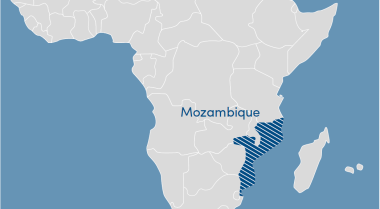
Operationalising the Peacebuilding and Sustaining Peace Agenda in Mozambique
This report first presents a brief overview of the peacebuilding context in Mozambique, briefly summarising the current state of affairs in the...
-
Advancing Change towards Sustainable Peace: Financing Locally-Led Peacebuilding Action
Global peacebuilding policy widely recognises that sustainable peace requires the meaningful engagement of local stakeholders. Indeed, peacebuilding...
-
-

Effective Options for Financing Local Peacebuilding
For peacebuilding to be more effective and sustainable, local communities need to be in control of their own peacebuilding efforts. This means that...
-
-
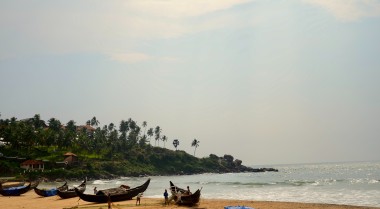
Localisation of Climate-Security Risk Assessment: Developing a Guidance Note as a Resource for Sustaining Peace
In response to the growing challenges of climate security, in 2018 the UN Department of Political and Peacebuilding Affairs (DPPA), UN Development Programme (UNDP) and the UN Environment Programme (UNEP) joined forces to establish the Climate Security Mechanism (CSM). Since then, the CSM has developed a toolbox that provides a broad framework for a holistic and systematic approach to climate security.
Recognizing that climate-related security risks are highly context-specific, with varied impacts across regions, countries, and communities, and therefore requiring integrated analysis and responses, the Global Partnership for the Prevention of Armed Conflict (GPPAC), Plataforma CIPÓ and the United Nations Development Programme (UNDP) have partnered to develop a Guidance Note for localising climate security risks. The guidance note builds on the work of the CSM, further integrating climate security risk assessment at the community/ local level, enabling a user-friendly approach led by the local communities, and enhancing local ownership and active participation.
The Guidance Note will provide practical avenues and suggestions for considerations of local climate and security experts in specific contexts on how to:
- design and conduct integrated local climate security risk assessments based on locally determined and intersecting indicators related to climate risks and risks to conflict and fragility
- communicate findings to relevant local, national and regional stakeholders responsible for prevention and risk management.
Purpose: This expert-level informal dialogue will bring together climate security experts to provide feedback on and validate the draft Guidance Note and exchange existing methodologies and tested practical experiences in localisation of climate security risk assessment, prevention and early warning. The discussion will help to understand the relevance of the Guidance Note and to improve methodological approaches that underpin local climate risk assessment, prevention and early warning practices, ahead of the launch of the report in various countries. The Guidance Note, when finalised, will be a resource for climate security experts to promote and build on local resilience and support communities in their work of addressing climate security concerns.
RSVP: Please kindly RSVP to un.liaison@gppac.net by 18 April 2022
-
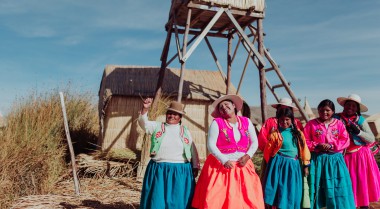
The High-Level Meeting on Innovative Solutions for Feminist Financing for Peacebuilding
This roundtable will provide an opportunity for the Member States, multilateral partners, private sector, and civil society to identify concrete actions needed for more inclusive, impactful and fit-for-purpose financing in the follow-up of the High-Level Meeting. Specifically, the participants are invited to share how the institutions they represent can commit to enhancing current financing mechanisms by drawing upon some of the recommendations from the “Feminist Solutions for more Impactful Financing for Peacebuilding” paper. Furthermore, the participants are welcome to jointly reflect on the possibility of ensuring that such efforts take into consideration principles of quality financing and are implemented to ensure the highest possible impact at the country level.
The discussion will be guided by the following questions:
- What type of mechanisms work for women peacebuilders operating on the ground? What are the key principles donors should take into consideration to maximise the impact of funding? How can this be supported by donors, host countries and other actors?
- What are some examples of concerted action on Women, Peace and Security, including on financing the WPS agenda and ensuring women’s access to resources? What are the potential and/or evident benefits of such financial mechanisms? How can the existing commitments to financing for women peacebuilders be materialised?
- How can the donor community capitalise on the opportunity presented at the High-Level Meeting on Financing for Peacebuilding? How can civil society and the WPS-HA Compact support further efforts to encourage the thinking and action towards more impactful and feminist financing for peacebuilding?
We organise this roundtable together with the Global Network of Women Peacebuilders (GNWP), International Civil Society Action Network (ICAN), Kvinna till Kvinna,
Permanent Missions of Bangladesh, Ireland and Sweden to the United Nations, UN Women, and Women’s International League for Peace and Freedom (WILPF).Read the full concept note here.
Register here to join the discussion.
-
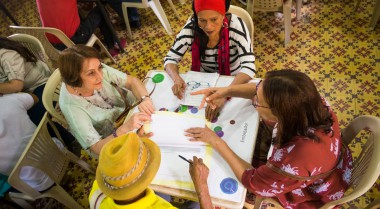
Roundtable: Funding Local Peacebuilding
In connection with the High-Level Meeting on Financing for Peacebuilding, the UN Department for Political and Peacebuilding Affairs and the Peacebuilding Support Office are hosting a high-level informal and interactive roundtable on funding local peacebuilding.
The hope is that the roundtable will facilitate discussion on action-oriented outcomes for the High-Level Meeting of the General Assembly (Wednesday 27 April) to address the financing gap for prevention and peacebuilding in the context of fast-changing, protracted and increasingly complex violent conflicts.
The roundtable will be moderated by our former board member Mariska van Beijnum. Our member Khaled Emam will share his insights.
Click here for more information.
-
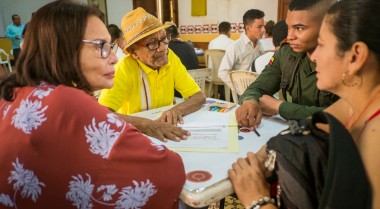
Roundtable: Peacebuilding Fund (PBF) Results and Resourcing
In connection with the High-Level Meeting on Financing for Peacebuilding, the UN Department for Political and Peacebuilding Affairs and the Peacebuilding Support Office are hosting a high-level informal and interactive roundtable on the Peacebuilding Fund (PBF) results and resourcing.
The hope is that the roundtable will facilitate discussion on action-oriented outcomes for the High-Level Meeting of the General Assembly (Wednesday 27 April) to address the financing gap for prevention and peacebuilding in the context of fast-changing, protracted and increasingly complex violent conflicts.
During the roundtable, our member Tajyka Shabdanova will reflect on her experience leading the Youth Empowerment in Kyrgyzstan project funded by the UN PBF Gender and Youth Promotion Initiative.
Click here for more information.
-
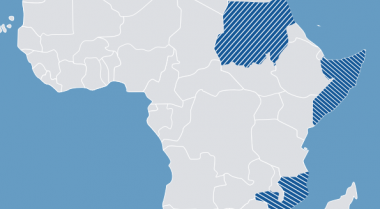
From Rhetoric to Practice: Concrete steps to support the implementation of the Peacebuilding and Sustaining Peace Agenda
This synthesis report summarises the key insights coming out of the three case studies in Sudan, Somalia and Mozambique, and is meant to serve as a re...
-

Principles for Quality Financing for Peacebuilding and Conflict Prevention: Practical Avenues to Improve Support for Local Peace Actors
This paper suggests practical avenues to improve financial support for local peace actors whose work is an essential complement to international...
-

La amenaza del iliberalismo. Reflexiones y desafíos para la defensa de la democracia desde cuatro perspectivas
Una serie de entrevistas con expertos, entre ellos el politólogo Miguel Ángel Martínez Meucci; la historiadora y periodista Anne Applebaum; el...