 A Network of People Building Peace
Search results
-

Transitioning Towards Green Economies: Policy Papers on Renewable Energy Sources in the South Caucasus
In the South Caucasus region, GPPAC members recognize that cooperation in the area of renewable energy sources has the potential to become an...
-
-
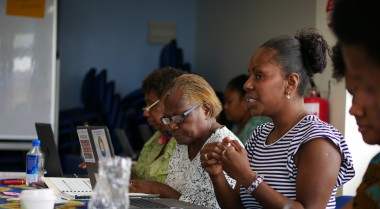
Feminist Financing for Climate Justice starts with Us!
Pacific Young Women Transforming Climate Crisis to Climate Justice
-
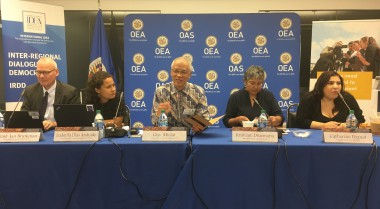
Achieving Peace, Justice and Strong Institutions at the Regional Level
This Policy Brief aims to provide a practical channel to present the main findings and recommendations that were distilled from the discussions that...
-
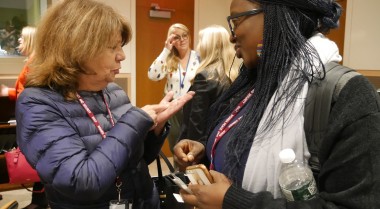
Feminist Solutions for Impactful Financing for Peacebuilding
Together with the Global Network of Women Peacebuilders (GNWP), the International Civil Society Action Network (ICAN), Kvinna till Kvinna, and UN Women, we are hosting a virtual high-level roundtable discussion: “Feminist Solutions for Impactful Financing for Peacebuilding” on November 8, 2-3:30 pm CET.
With this discussion, we will bring together local women peacebuilders and representatives of the UN, Member States, and civil society. The discussion will provide space to highlight the barriers to sustainable funding experienced by local women peacebuilders, share existing good practices from peacebuilding stakeholders and propose further solutions that can support local women peacebuilding work in a meaningful and effective way.
During the discussion, we hope to engage in a dialogue on the following topics:
- What are the key persistent barriers that local women peacebuilders face in accessing funding for their work?
- What are some of the best practices in supporting local peacebuilding work? What makes them good practices? How can other actors replicate or support such initiatives?
- What are the limitations experienced by donors and what are some of the ways to address or overcome these limitations?
- What concrete steps can Member States and UN actors take to ensure that local women peacebuilders’ priorities and recommendations are represented at the High-Level Meeting on Financing for Peacebuilding (to take place in 2022) and that actions to realize these recommendations are sustained beyond the High-Level meeting?
- What are the steps Member States and the UN actors can take to ensure that local women peacebuilders’ reflections are represented at the High-Level Meeting on Financing for peacebuilding? How positive action can be sustained beyond the High-Level Meeting?
Read the full concept note here and join the discussion by registering here.
-
-
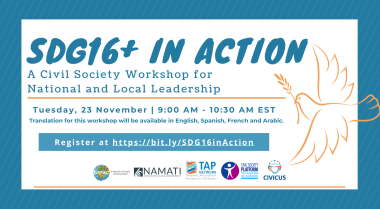
SDG16+ In Action: A Civil Society Workshop for National and Local Leadership
Hosted by the TAP Network, the Civil Society Platform for Peacebuilding and Statebuilding (CSPPS), Namati, CIVICUS, and the Global Partnership for the Prevention of Armed Conflict (GPPAC)
*Translation for this workshop will be available in English, Spanish, French, and Arabic*
Join us for a virtual workshop that will explore ways that civil society can enhance efforts to support bold and ambitious commitments to SDG16+, and will showcase opportunities for civil society to mobilize around to advance SDG16+ at the global and national levels. This event will be hosted in a workshop style, and will provide an opportunity for direct engagement and learning amongst participants.
With the goal of providing a platform for peer-learning amongst civil society partners, this workshop will provide opportunities for national and local CSOs to dialogue and share experiences around SDG16+ in an interactive and dynamic exchange. It will feature encouraging case studies for civil society to learn from, including examples from the CSPPS Ready for Review project, and will provide an opportunity for learning and sharing amongst participants in attendance, and will showcase concrete tools and resources for civil society, such as the SDG16+ Civil Society Toolkit.
At the global level, the event will explore new TAP Partner Action Platform, which showcases concrete civil society commitments and actions to advance SDG16+ and SDG accountability from organizations around the world. In addition to highlighting the ambitious work of CSOs around the world, this platform also looks to provide a foundation for fostering greater collaboration, learning and engagement amongst civil society partners around SDG16+. It will also highlight the Rome Civil Society Declaration for SDG16+ – a global call-to-action from civil society for governments to urgently implement SDG16+ – and the global storytelling initiative, the Voices of SDG16+ Campaign, which seeks to elevate local civil society voices at the global level. It will also feature the work of the SDG16+ Localization Consortium – a coalition of global SDG16+ CSO networks working to strengthen capacities of civil society to effectively mainstream and localize SDG16+ within countries. This event will showcase how these platforms can support and propel action and exchange between civil society partners at the national and local levels.
Please make sure to register for the event here: https://bit.ly/SDG16plus
Background
Since the adoption of the 2030 Agenda in 2015, progress towards SDG16+ has been slow and uneven – and in many cases backsliding. On top of this, global trends and forces continue to work against peaceful, just and inclusive societies, with political will from governments fading, financing lacking, and exclusion on the rise. The COVID-19 pandemic has placed unique pressures on the world’s governing institutions, presenting once-in-a-generation challenges for all, while exacerbating existing global, existential challenges. However, in the absence of governments’ commitment to SDG16+, civil society has played a leading role in advancing peaceful, just and inclusive societies, and will continue to play a critical role in ensuring that progress is made in this Decade of Action and Delivery for the SDGs.
-
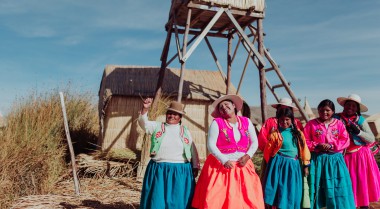
FUND US LIKE YOU WANT US TO WIN: Feminist Solutions for more Impactful Financing for Peacebuilding
The international community recognises that adequate, predictable and sustained financing for diverse women peacebuilders is an imperative...
-
-
-
Youth Peacebuilding Leaders on Implementing S/RES/2250, Financing, and Protection
The objective of this dialogue is to amplify the experiences, strategies and approaches of young local peacebuilders towards the implementation of UNSCR2250, jointly reflect on the impact of this work, and facilitate exchange of practical avenues to support quality financing mechanisms that place youth ownership at the core of peacebuilding action.
In many conflict-affected regions around the world, the majority of the population are below the age of 30. Youth are often scapegoated as the reason for the ills of their community and country, though in actuality it is often these young people who are at the forefront of mobilizing for positive change. Local peacebuilders still find ways to amplify the impact that young peacebuilders are making on the ground to advance peace and solve conflict in their communities.
Recognising youth leadership, the United Nations Security Council adopted Resolution 2250 (2015) on Youth, Peace & Security (YPS) recognises and empowers the positive agency of youth while calling on Member States to act in kind.
Since the adoption of Resolution 2250 (2015), two subsequent Resolutions have been adopted by the United Nations Security Council - Resolutions 2419 (2018) and 2535 (2020). Under the leadership of Egypt, the Peacebuilding Commission has also developed the Strategic Action Plan on Youth and Peacebuilding. At the national level, there is increasing momentum with the recent adoption of National Action Plans in Finland and Nigeria, as well as the introduction of legislation in the United States Congress.
However, young peacebuilders continue to experience challenges in amplifying and sustaining their work. Even when engaged in YPS implementation, young people are still excluded from many of the general peacebuilding processes and available financial resources. Further, the finances available to them do not allow for their adequate protection, within the context of “shrinking civic space” exacerbated during the COVID-19 pandemic. While young people lead movements to address climate change as well as movements like Black Lives Matter, #EndSARs, and in Myanmar/Burma, Colombia, Afghanistan and other countries; they also are more likely to do so voluntarily and constitute one of the top demographics to experience violence as a result of their activism.
Opportunity for action on financing for peacebuilding: Providing young peacebuilders with the resources they need to launch their own initiatives has received positive feedback and achieved good results. In response to the funding gap faced by young peacebuilders, both GPPAC and Peace Direct, as well as other peacebuilding partners in the field, have piloted innovative funding mechanisms that center around principles of authentic partnership, participatory grantmaking and a holistic support approach. With funding from the Swedish International Development Agency (SIDA), Peace Direct launched the Youth Action for Peace Program (YAPP) in Mali, the Central African Republic, the Democratic Republic of Congo, and Pakistan, working with youth-led organizations to provide small flexible programme grants to other youth-led organizations and movements. Similarly, GPPAC’s Youth-by-Youth Methodology provided an opportunity for GPPAC’s YPS Working Group to take the lead in the development of a Small Grants scheme that supported the innovative ideas of young peacebuilders across the network.
This open dialogue builds on the existing progress achieved in the implementation of the YPS Agenda, as well as serves to support the work of the UN SG’s Envoy for Youth and the Deputy Secretary General in recognizing and empowering youth and to inform the discussions ahead of the 2022 High-Level Meeting on Financing for Peacebuilding by sharing the examples of participatory funding mechanisms that can effectively support youth leadership in peacebuilding.
The open dialogue will shed light and generate discussion on the following questions:
- What are the good practices of youth-led peacebuilding action? How are these activities financially supported?
- What are the opportunities and challenges that young peacebuilders highlight from their own fundraising efforts? What are some of the elements of a “quality” grant?
- How can the donor community support youth in being more constructively included in peace processes and protect them from violence, including targeted at them? What can the UN and other international partners do to enhance their support for youth peacebuilding?
To join this event, please register here.
For more information about this event, please contact Amanda Huits at a.huits@gppac.net
-