 A Network of People Building Peace
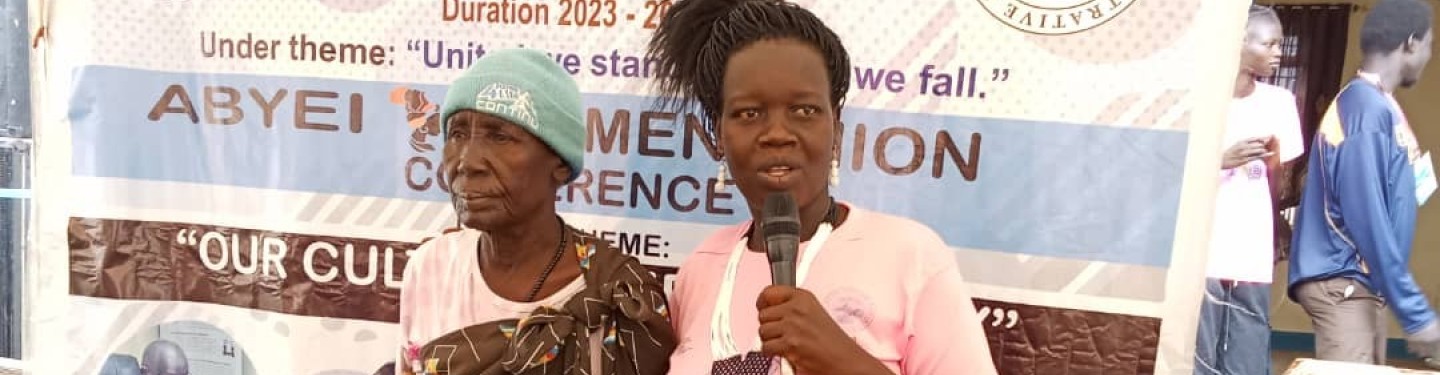
From survival to leadership: How one woman leads peacebuilding in Abyei
Akuot Chol, 45, offers a rare glimpse into life in Abyei, a fragile and disputed territory between Sudan and South Sudan. Her story traces a journey from childhood displacement to deep community belonging. Today, she stands at the forefront of local peacebuilding, amplifying women’s voices and empowering them to play a key role in keeping their communities safe.
A childhood shaped by the Sudanese civil war
Akuot’s commitment to peacebuilding originates in conflict, the day she first learned to swim by crossing the icy Kiir River, fleeing her village on a winter morning in 1985. ''We had no choice. We had to run,'' she recalls that day when the second Sudanese civil war reached her family's doorstep. While fleeing, Akuot lost her younger sister and grandfather. The family eventually settled in Abyei, an oil-rich region that has been caught in political limbo for many years.
To understand the significance of Akuot’s peacebuilding work, it is important to understand the long, complex, and contested history of Abyei.
Abyei’s contested status and the roots of ongoing tensions
Abyei’s political status has remained unresolved since the 2005 Comprehensive Peace Agreement, which ended the nearly 22-year-long second Sudanese civil war. It left the area suspended between Sudan and South Sudan, administered as a special area overseen by international actors, including the African Union (AU) and United Nations Interim Security Force for Abyei (UNISFA). In Abyei, tensions are especially intense between the Ngok Dinka, a subgroup of the Dinka who identify more with South Sudan, and the Misseriya, a nomadic Arab group allied with Sudan over territorial claims. Abyei was meant to hold a referendum in 2011 to let Abyei residents decide whether to join Sudan or South Sudan, but disputes over voter eligibility, particularly whether the nomadic Misseriya could participate, prevented it from taking place.
Akuot puts it plainly: ‘’In Abyei, conflict never really ends. Whenever people try to recover and heal, another crisis begins.’’ Yet when asked about life in Abyei, conflict is not what she speaks of first. “In Abyei, everyone is welcome, no matter where they come from.” Still, she acknowledges the harsh reality beneath that openness. Communities continue to live with the long-term effects of violence, of the loss of family members, repeated displacement, and the destruction of homes and livelihoods. For many, trauma is not an exception but a shared experience.
Turning survival into peacebuilding leadership based on trust
Ever since that day she learned how to swim, Akuot has refused to be swept away by the difficult circumstances of the place she calls home. What once was a fight for survival in icy waters has become a lifelong commitment to helping others navigate the effects of conflict and move toward sustainable peace. With a proud smile, Akuot shares ‘’I am a mobiliser and facilitator.’’ What does that look like in practice? In her role with a small, locally-led organisation called Dectro, financially supported by Women’s Peace and Humanitarian Fund (WPHF), Akuot invites Ngok Dinka and Misseriya women to participate in peacebuilding training. She does not approach them alone. Instead, she collaborates closely with community leaders, primarily local chiefs, women leaders, and authorities, who serve as essential entry points into both communities. These leaders help identify women participants and provide the legitimacy needed to engage safely across divided lines. When asked how she built such trust with community leaders, she smiles and says, “I have done all kinds of peacebuilding work in my community since 2000. People know me.” For Akuot, the answer is simple. Trust comes from staying and from being present.
The impact of bringing women from across divides together
Together with community leaders, Akuot has successfully brought women from communities long divided by conflict. “They didn’t talk to each other. They might meet in the market, but never sat down to talk,” Akuot recalls. “There was mistrust. Ngok women thought Misseriya women were happy with the fighting, and vice versa. But when we finally sat together, we realised we were all suffering the same losses. We heard the pain from the other side. None of us wanted the fighting.”
Akuot recalls one powerful moment that revealed the strength of women coming together across divides. During a dialogue in Wau, West Bahr el-Ghazal State, women gathered to share their stories. In the middle of the discussion, a grieving mother who had lost her child to violence stood up and said, “I don’t want other women to feel the same pain.”
Her words pierced the room. Many women, who too had lost loved ones, rose in solidarity. Some wept openly, others clasped hands tightly, but all stood united. In that moment, they pledged to reject revenge and choose peace.
“It was powerful,” Akuot says with a smile. “From that day, we agreed: if there’s a dispute, we sit and talk. No more fighting.”
Reflecting on moments like this, Akuot speaks with conviction: “Peace starts at the grassroots level.” She has seen it firsthand. “When communities are supported to solve their own problems, peace can grow, and it can last.” Yet, she also knows how fragile these gains are. Grassroots women peacebuilders like her remain far removed from the decision-making tables, especially at the regional level. For Akuot, this is both a source of frustration and a reason to keep working. “Women are still seen as survivors, not leaders,” she says. “We are invited to meetings, but our voices are rarely taken into account.” Her words are a sober reminder that over 25 years after the adoption of United Nations Security Council Resolution 1325, stressing the importance of women’s equal participation and full involvement in all efforts to maintain and promote peace and security, the women of Abyei remain excluded.
Sit with women. Listen to them.
Akuot remembers the brave woman in Warrap, whose pain became a call for others to stop fighting. Just like that woman, Akuot does not want history to repeat itself. “I don’t want my children to go through what I did: displacement, trauma, fear.” Akuot works towards a future where women lead peace efforts, not from the margins, but from the heart of decision-making, whether in circles of plastic chairs at the community level, in conference rooms at the African Union in Addis Ababa or the Headquarters of the United Nations in New York. No matter the setting, she urges, “Sit with women. Listen to us. We know what needs to be done. We have solutions to the challenges we face. If you empower grassroots women, peace will come. And it will be cheaper, more effective, and more lasting than anything imposed from the outside.”
Akuot’s work is part of the project From Grassroots to Peace Tables: Abyei Women Leading Peace Dialogues on the Sudan-South Sudan Border, implemented by Detcro in partnership with GPPAC and financially supported by the United Nations Women’s Peace and Humanitarian Fund’s Rapid Response Window.
Related highlights